Next-Generation Analytics and Enterprise BI Support: Power BI & Fabric Implementation
Supporting and scaling a global reporting ecosystem, resolving performance bottlenecks, and pioneering Copilot Studio integrations.
Client Identity
Microsoft
Assigned Role
Senior Power BI Developer L2
Timeline Window
October 2024 – January 2025
Integration Agent
Sonata Software Limited
The Business & Technical Challenge
Operating at Microsoft's global enterprise scale means managing datasets that aggregate hundreds of millions of transaction records daily. With hundreds of internal stakeholders requesting ad-hoc data extractions and custom views, the core reporting pipelines faced performance degradation. Issues like refresh failures on complicated on-premises gateways, memory errors, and query latency on tabular datasets threatened daily operational visibility. Microsoft required continuous, high-level technical oversight to scale, secure, and modernize their massive reporting layers.
The Engineered Solution
As a Senior L2 Developer, I spearheaded performance diagnostics and support. I rebuilt relationship structures, streamlined hierarchies to decrease memory card sizes, and utilized VertiPaq optimization to accelerate cache hits. We introduced custom Composite Models, using Aggregation Tables to process high-level metrics rapidly while pushing raw granular queries down to relational warehouses. In addition, I designed and connected customized Microsoft Copilot Studio interfaces directly into live semantic models, allowing business leaders to query metrics like 'MTD revenue variations' inside automated chat interfaces, deflecting recurring ad-hoc tasks.
Large-Scale Optimization & Conversational AI Integration
Tabular Memory Scaling
Designed Composite models mapping pre-aggregated tables on top of millions of records, bypassing server timeout locks using VertiPaq analyzer insights.
Copilot Conversational Engine
Connected conversational chatbot nodes directly with underlying semantic sets, shielding developers from redundant ad-hoc data demands.
Architectural Phases & Implementation Details
L2 Performance Audit
Conducted systematic diagnostic checks using VertiPaq Analyzer to detect high-column cardinalities and slow DAX expressions.
Model Modernization
Implemented Composite Models with Aggregation Tables to optimize cache speeds on deep time-series data.
Gateways & Scheduled Refresh
Re-engineered on-premises gateway networks and partition refresh schedules, minimizing peak-hour bottlenecks.
Conversational AI Integration
Mapped Copilot Studio workflows to Power BI semantic structures, creating natural-language conversational analytics.
System & Integration Architecture
High-fidelity technical blueprint representing Naveen's Microsoft project systems and integrations.
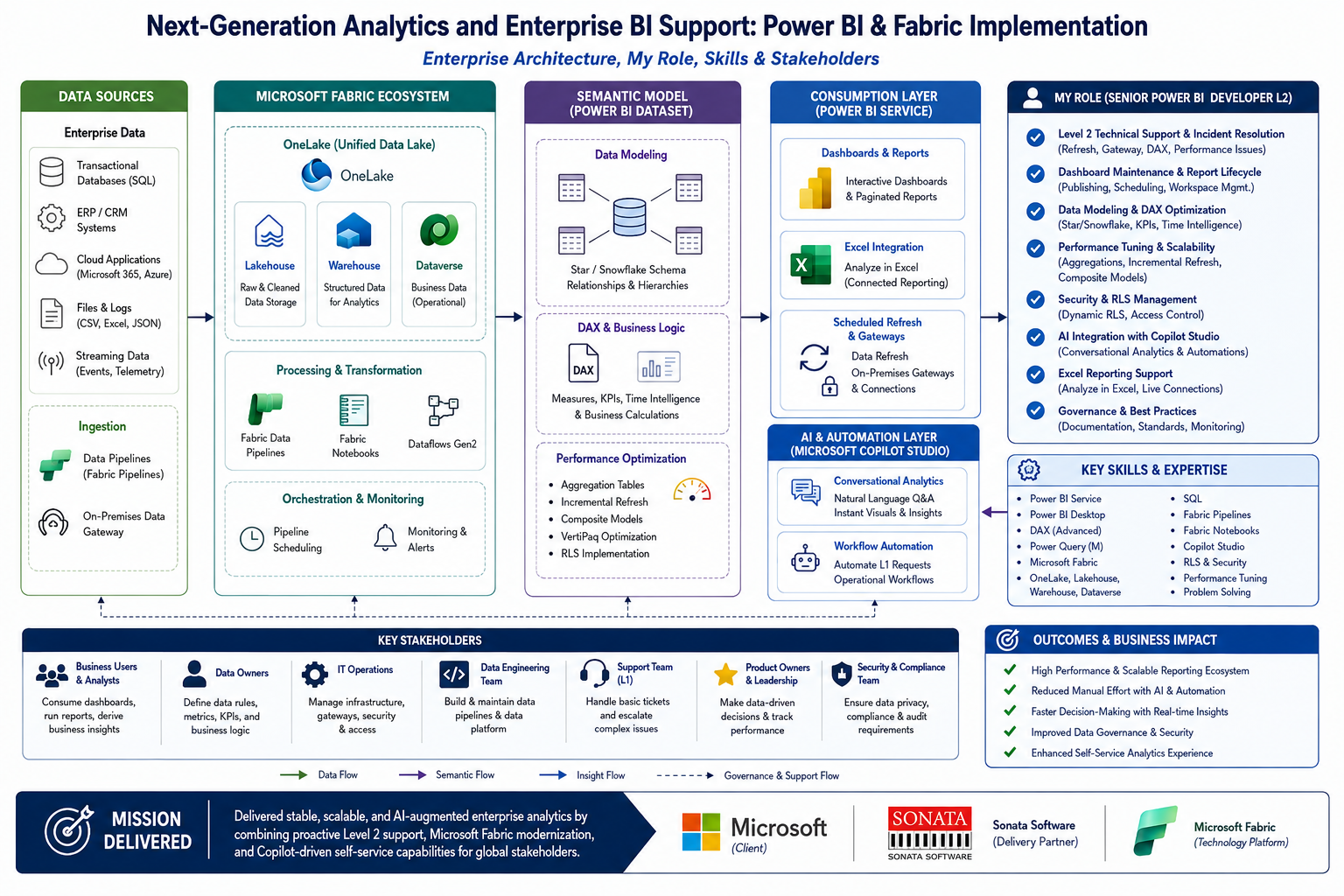
*Click diagram above to inspect technical stages, pipeline sequences, and technology stacks at full magnification.
Measurable Outcomes & ROI
Dashboard Optimization
15% Jump
In loading speeds and query responsiveness across key administrative dashboards.
Query Resolution Time
60% Faster
Incident turnaround on Level 2 workspace technical support tickets.
Support Deflection
30% Lower
Fewer ad-hoc pipeline requests through automated Copilot self-service channels.
Core Outcomes Narrative & Direct Impact
Through deliberate VertiPaq optimization, gateway tuning, and conversational AI embedding:
Engineering Summary Memo
Within Microsoft's fast-moving business intelligence landscape, we demonstrated that modern BI developers must combine system engineering with conversational automation. By focusing heavily on physical and semantic memory structures, we squeezed maximum computing power from their current fabric. Linking these models with custom conversational agents empowered administrative headers to interact with live data easily, eliminating support queues.