Accelerating Enterprise Data Modernization: Automated Informatica to Fabric Migration
Programmatically parsing legacy ETL XML files to auto-generate Power Query (M) scripts and T-SQL pipelines on Fabric.
Client Identity
Kanerika Inc.
Assigned Role
Microsoft Fabric Analytics Engineer
Timeline Window
August 2025 – October 2025
Integration Agent
Kanerika Inc.
The Business & Technical Challenge
Migrating complex, legacy on-premises ETL architectures like Informatica PowerCenter to modern, cloud-native platforms like Microsoft Fabric is a notorious bottleneck. Legacy workflows, filter routing, aggregator states, and custom expression rules are deeply locked inside proprietary Informatica XML formats. Traditional migrations require expensive, manual re-coding and line-by-line rebuilding of pipeline transformations, introducing severe errors, prolonged testing timelines, and high development costs.
The Engineered Solution
Within the FLIP product engineering pod, we architected a programmatic compiler. We engineered an XML deconstruction parser that deciphers mapping nodes, routing matrices, and transform definitions, organizing them into a standardized metadata schema. I built the code generation engine that took this structural schema and automatically translated the business rules into equivalent Power Query (M) code blocks for Fabric Dataflow Gen2, and T-SQL script snippets for warehousing optimization. We then leveraged Microsoft Fabric REST APIs to automate the remote generation of pipelines in the destination Lakehouse.
FLIP Migration Architecture: Informatica PowerCenter to Microsoft Fabric
Source XML
Proprietary Informatica pipeline mapping XML file loaded.
Compiler Parser
Translates mapping logic blocks into standardized metadata.
Code Generator
Compiles functional Power Query M equations and fast SQL files.
Fabric API sink
Deploys code-gen schemas directly inside OneLake Warehouses.
Architectural Phases & Implementation Details
Proprietary XML Ingestion
Ingested legacy Informatica PowerCenter XML layouts, decoding nested structural mappings and rules.
Metadata Mapping Compiler
Created structured parsing tables classifying Expression, Filter, Joiner, and Aggregator properties.
M Query & T-SQL Compiler
Constructed programmatic logic generators that code-gen functional Power Query M rows and highly-optimal T-SQL views.
Automated Orchestration
Triggered cloud-native Fabric Dataflow Gen2 layers through dynamic Fabric REST pipelines, avoiding manual setup.
System & Integration Architecture
High-fidelity technical blueprint representing Naveen's Kanerika Inc. project systems and integrations.
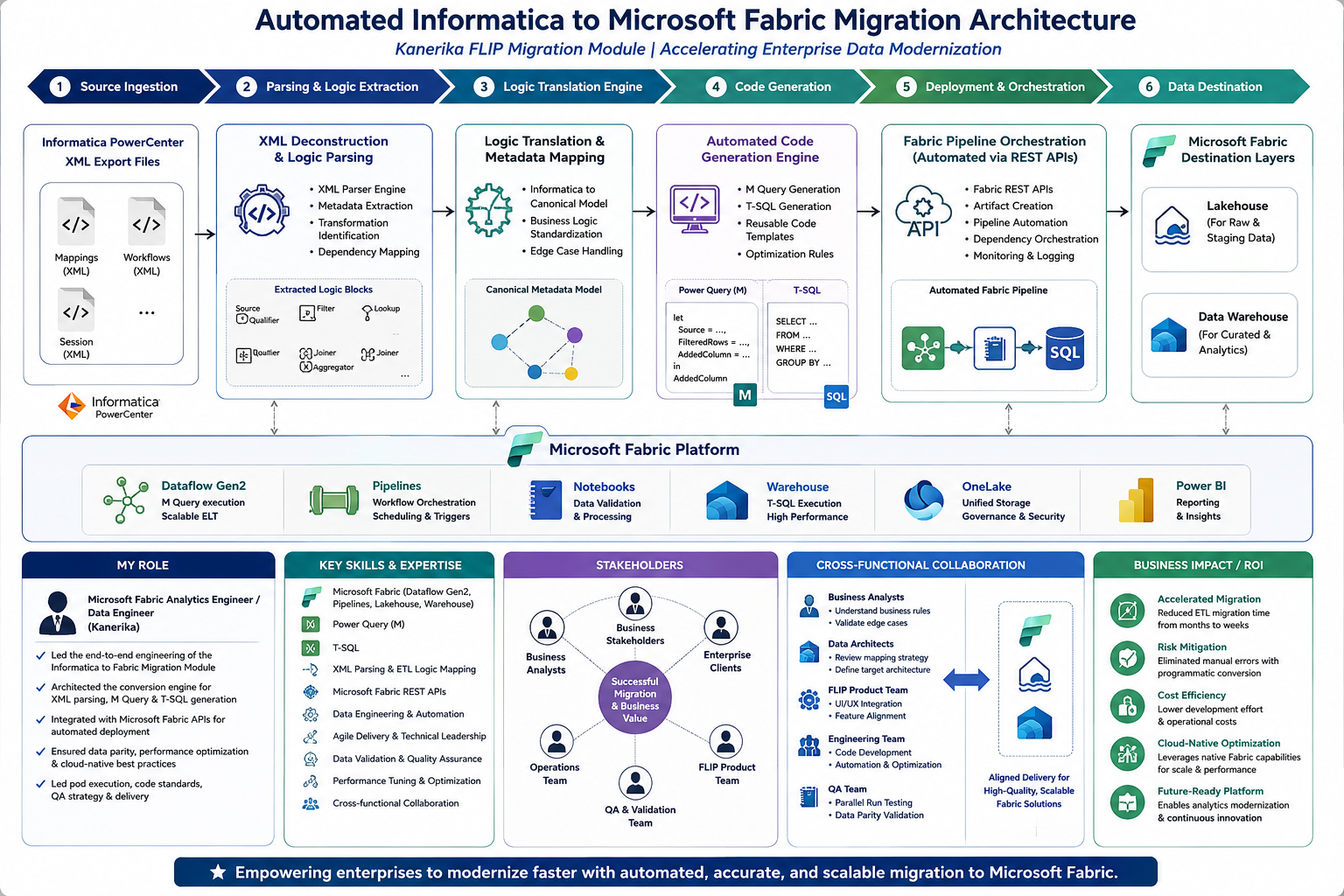
*Click diagram above to inspect technical stages, pipeline sequences, and technology stacks at full magnification.
Measurable Outcomes & ROI
Manual Effort Saved
40% Decline
In developer workloads required to extract, recreate, and test legacy pipelines.
Delivery Acceleration
Months to Weeks
For large enterprise clients updating heavily tangled legacy on-premises ETL arrays.
Migration Parity
100% Parity
Verified via systematic validation framework, comparing historical outputs with new pipelines.
Core Outcomes Narrative & Direct Impact
Using metadata compilers and automatic programmatic generation algorithms:
Engineering Summary Memo
Enterprise modernization projects are historically derailed by manual lift-and-shift operations. By utilizing programmatic automation to parse XML layouts and programmatically compile optimized M and T-SQL environments, we proved that data engineers can automate migration processes. This module accelerates time-to-value for enterprise customers scaling up clinical, manufacturing, or financial analytics on Microsoft Fabric.