Scaling Enterprise Analytics and Automated Governance: A Fabric-Driven Ecosystem
Unifying Molex's Snowflake and Fabric layers, automating metadata scripts on 180+ reports, and launching zero-trust automated testing.
Client Identity
Koch Industries
Assigned Role
BI Consultant
Timeline Window
March 2026 – April 2026
Integration Agent
Koch Industries (via Consulting)
The Business & Technical Challenge
Molex, a global manufacturing division of Koch Industries, maintains a massive global supply chain. They rely on over 180 Power BI dashboards powered by transactional Snowflake warehouses. The environment faced three main problems: first, there was no programmatic data discrepancy matching, leading to data trust complaints; second, minor database shifts required developers to manually modify bookmark and filter layout configurations across all 180+ reports; and third, it lacked visual analytics tracking cloud compute, demand projections, and cost management.
The Engineered Solution
We implemented an engineering-focused BI governance framework. Using PySpark, SemPy (Semantic Link), and Azure ADF inside Fabric, we wrote automated notebooks that queried the ground truth in Snowflake and cross-referenced it with the live Power BI semantic layer across 11 key metrics, logging drift immediately. To overcome report maintenance bottlenecks, I authored Python scripts to directly parse and modify Power BI metadata formats (PBIR). Integrated into a centralized Git flow, a single commit automatically updated report bookmark variables across 180+ reports via the Fabric CLI, avoiding manual clicks. I also built rich analytic layers for demand modeling and compute spending.
Governance Architecture: zero-trust monitoring & Metadata Updates
Source Cross-Audit
PySpark scripts integrated with SemPy (Semantic Link) directly query live Power BI sets, cross-checking 11 key KPIs against Snowflake to alert of data-drift immediately.
Metadata Compiler
Python batch updates query PBIR JSON files to edit bookmarks, filters, and dynamic layout constraints across 180+ reports automatically.
CI/CD Deployment
Synced through Git repositories. Commit actions run Fabric commands via the CLI to update enterprise workspaces with zero manual UI taps.
Architectural Phases & Implementation Details
Semantic Link Reconciliation
Built automated Fabric notebooks executing SemPy algorithms to match Snowflake source metrics with semantic models.
Metadata Automation Node
Wrote python batch processors mapping and modifying complex PBIR bookmark structures programmatically.
Git-Integrated Release
Configured automated CI/CD deployment routines using the Fabric CLI to commit changes directly into enterprise workspaces.
Compute & Forecaster Dashboards
Launched internal supply capacity demand monitors and automated Fabric capacity billing telemetry.
System & Integration Architecture
High-fidelity technical blueprint representing Naveen's Koch Industries project systems and integrations.
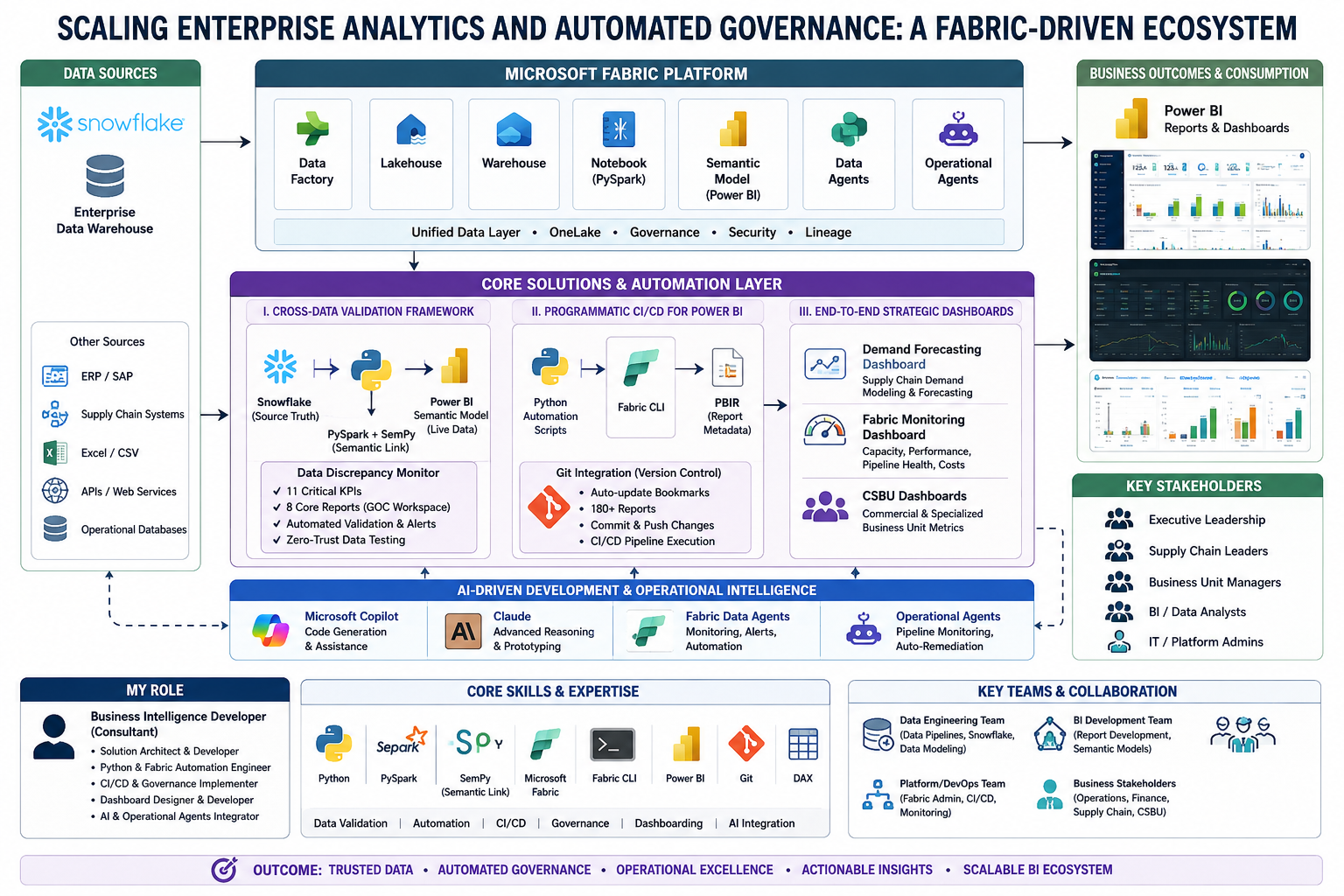
*Click diagram above to inspect technical stages, pipeline sequences, and technology stacks at full magnification.
Measurable Outcomes & ROI
Release Overhead
60% Reduction
In average cycle times needed to deploy layout updates across report suites.
Data Trust Parity
100% Trust
Achieved across monitored datasets due to automated proactive discrepancy alerts.
Automation Scope
180+ Reports
Synchronized with zero-click programmatic governance pipelines in Git.
Core Outcomes Narrative & Direct Impact
Through Git-integrated metadata pipelines, SemPy drift reviews, and PySpark audits:
Engineering Summary Memo
This consultation at Koch Industries represents the absolute future of enterprise Business Intelligence. By treating report structures as raw, readable code instead of proprietary locked interfaces, we introduced software engineering hygiene (CI/CD, version control, programmatic tests) to Power BI. It eliminates tedious manual clicks, guarantees absolute data consistency, and allows analytics teams to scale operations effortlessly.